A Fieldworker’s Guide to Working in Bear Country

Working outdoors in Alberta and British Columbia means one thing is guaranteed: most of the time, you’re working in bear country. If you’re in the Boreal Forest, the foothills, or the valleys and slopes of the Rocky Mountains, bear awareness is a necessary part of the job. Understanding their behaviour, knowing how to avoid encounters and being prepared to respond appropriately, helps keep our crews safe.
Know your neighbours
Much of North America, especially western Canada, is home to both black bears and grizzly bears. Knowing the species matters because they behave differently and require different responses if ever encountered.
Black bear
The more common species
Typically found in heavily forested areas. Adults usually weigh between 200-400 lbs and range in colour from black to various shades of brown or even blonde.
Look for longer, prominent ears, a straight facial profile, a flat upper back, short, curved claws, and tracks with a wide toe arc where the smallest toe is set noticeably back. A useful saying goes “one toe back means black.”
Grizzly bear
Larger and more defensive
More commonly found in open terrain such as upland meadows, mountain valleys and foothills. They are larger than black bears, with most adults weighing 400-800 lbs and are identifiable by a prominent shoulder hump and dish-shaped face. Colour is never the best indicator of species as grizzlies can also range from black to blonde.
Look for silver-tipped or grizzled fur and tracks with long claw marks (often 2-4 inches), and toes that are closer together, in a straight line or nearly touching.
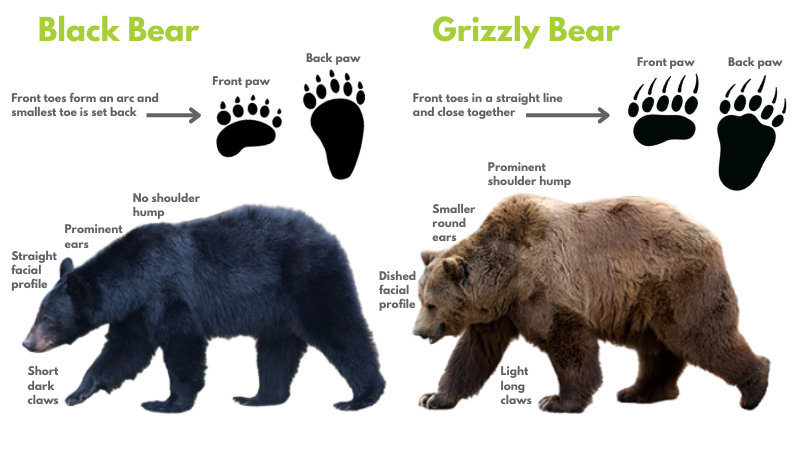
This image and the content it contains has been recreated using an image from the Government of Alberta
Although bears typically want to avoid us as much as we do them, surprising a bear at close range, or a mother defending cubs, can become extremely dangerous. The goal is to avoid these scenarios entirely.
Reading the signs

Before an encounter happens, the environment often gives you a heads-up. Keep an eye out for bear tracks, scat, or claw marks on standing trees (which are easy to see on Aspen’s). Fresh signs mean bear activity is recent and nearby. This is when it’s worth slowing down, communicating with your crew and increasing your awareness of the surroundings.
“The best bear encounter is the one that never happens.”
Except maybe from a very very safe distance inside your vehicle because let’s be honest, that would be pretty cool.

Avoiding encounters
The good news is most bear encounters can be avoided with good field practices. Always let someone know exactly where you’re going and how long you expect to be there. It’s important to use the buddy system whenever possible (although, at Circle, you’re never alone in the field) and have reliable communication devices such as an inReach or satellite phone. Make lots of noise. Conversation, whistles and calling out can prevent surprising a bear at close range. Hey, even a little karaoke session in the woods wouldn’t hurt since no one is really around to judge.
Food management is also very important. If you are staying at a camp or remote worksite, keep the area clean by properly disposing of all garbage and food waste. Food odours do attract bears, however that does not mean you need to go hungry in the field. It’s perfectly fine to enjoy your go-to sandwich or last night’s leftover pizza, just be sure to pack your lunch in an enclosed container and don’t leave any crusts or wrappers behind.
If you encounter a bear

The first order of business is to stay calm. Yes, easier said than done, but it is the most important thing. Sudden movements or screams can trigger a chase response which is what you don’t want. Take some deep breaths, stay together as a group, speak in a low, firm voice and back away slowly. If the bear continues to approach, make sure your bear spray is already in hand ready to use. If you can do so safely, use your communication device to call for help and move carefully towards the closest vehicle or structure if possible.
How you respond from there depends on the species and type of encounter.
Black bear – predatory behaviour
Stand your ground
If a black bear moves towards you quietly with its head and ears up, it may be acting predatorially. Do not run or climb a tree because black bears are fast and excellent climbers. If approached, fight back, make yourself look large, yell in a deep voice and show it you’re not an easy target!
Grizzly bear – defensive encounter
Play dead
Huffing, teeth-clacking and bluff-charges are all warning displays. If a grizzly does charge directly at you, drop to the ground face down and protect your neck by clasping your hands behind your head. Use your elbows, knees and toes to stay flat on the ground and stay in this position until you are certain the bear has left.

After any encounter or near-miss, you must report it to both your supervisor and the local wildlife office or appropriate authorities. It matters for the safety of future crews and for wildlife management in the area.
Bear spray
Bear spray is a non-lethal pepper spray designed specifically to deter bears at close range. It is widely regarded as more effective than a firearm in a bear attack as a wounded bear is likely to become more dangerous, not less. Every crew member must carry their own, always in a hip or chest holster where it can be reached instantly. Never in a backpack. That will do you no good! Note to always check the expiration date because they lose their effectiveness over time.
How to deploy
- Remove the safety clip (the clip should be in place at all times except right when you’re about to use it).
- Aim at the bear’s face, or slightly downward because the spray will rise as it disperses.
- Deploy when the bear is within 6-10 metres, or 20-30 feet away. Bears can run up to 60km/hr so timing is critical.
- Spray until the bear stops or flees then leave the area immediately.
Storage and transportation
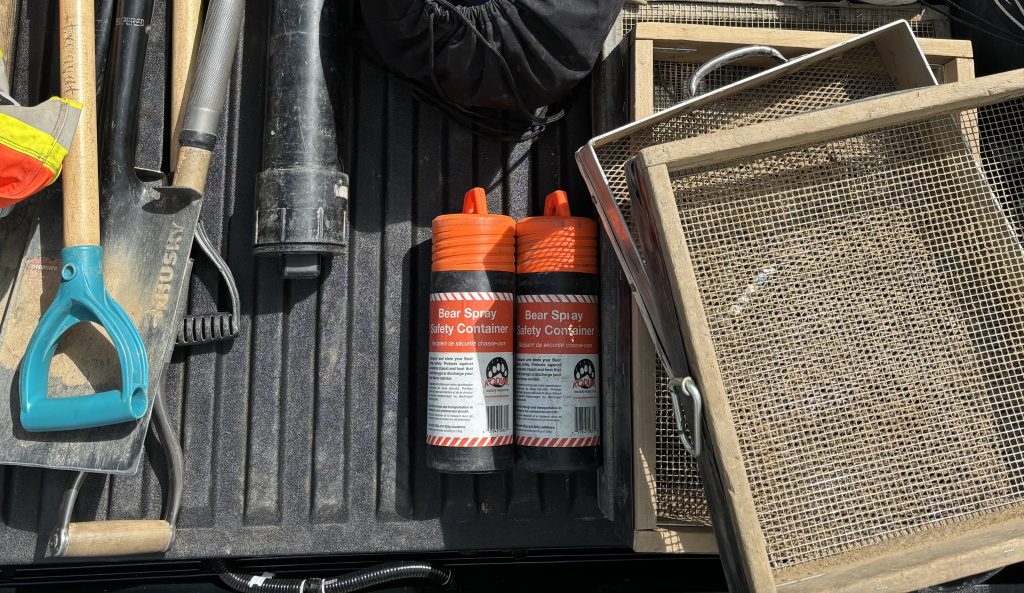
- Always store in a secure canister in the trunk or back of the vehicle. Never keep it loose inside.
- Keep out of direct sunlight and away from heat sources.
- The safety clip must stay on at all times unless you are preparing to use it.
Bears are an important part of the ecosystems we work in and sharing space with them comes with responsibility. With awareness, preparation, good habits and the right equipment, we can reduce risk and keep both ourselves and wildlife safe. Stay alert out there!

SHARE THIS:


